September 30, 2026 • 13 min read
Finding the right rental property can take time, especially if you have an animal. Pet restrictions, additional deposits, breed or size limitations, and no-pet policies can quickly narrow down your options.
If your animal provides emotional support related to a disability, though, you may be wondering whether different rules apply.
Can a landlord refuse an emotional support animal? Do you need an ESA letter? What happens if the property has a strict no-pet policy? And does having an ESA certificate make the process any easier?
The answers depend on several factors, including where you live, the type of accommodation you are requesting, and the laws that apply in your area.
In this article, we’ll explore what you should know when renting with an emotional support animal and how to approach the conversation with your landlord.
An emotional support animal (ESA) is an animal whose presence provides comfort, companionship, and emotional support to a person with a mental health condition.
Unlike service dogs, ESAs are not individually trained to perform specific tasks directly related to the individual’s disability. Instead, the benefit may come from companionship, routine, emotional reassurance, and the comfort of having the animal nearby.
Caring for an animal can also become an important part of everyday life. Feeding them, walking them, playing together, grooming them, and simply having another living being around can provide structure and a sense of purpose.
This is different from a psychiatric service dog, which is individually trained to perform disability-related tasks, such as retrieving medication, interrupting repetitive behaviors, responding to a panic attack, or providing a trained grounding response.
That distinction is particularly important when it comes to housing because the legal treatment of emotional support animals has been changing.

It is possible to rent with an emotional support animal.
Some landlords allow pets anyway, in which case the process may be fairly straightforward. Others have restrictions on the number, type, size, or breed of animals allowed on the property. You may also come across properties with a complete no-pet policy.
Having an ESA does not automatically mean that every landlord must accept the animal in every situation.
The rules can depend on federal law, state and local legislation, the type of property, and whether the animal qualifies for protection under the laws that apply to you.
This is why it is important to check the current requirements in your area rather than assuming that an ESA certificate or ID card will be enough.

This is an important area to be aware of if you are renting in the United States.
For many years, HUD guidance treated emotional support animals as part of the broader category of assistance animals for Fair Housing Act accommodation purposes.
In September 2025, HUD replaced its previous 2013 and 2020 guidance on assistance animals. In May 2026, HUD's Office of Fair Housing and Equal Opportunity, known as FHEO, issued new enforcement guidance explaining how it would approach animal accommodation complaints.
Under this newer enforcement position, FHEO focuses on animals individually trained to perform work or tasks connected to a person's disability. An animal whose role is limited to providing emotional support, comfort, or companionship without specific task training is not treated in the same way for enforcement purposes.
As a result, FHEO generally will not find reasonable cause for a Fair Housing Act violation simply because a housing provider refuses to accommodate an untrained ESA. You can read the full HUD Enforcement Guidance on animal accommodation requests.
However, there is an important distinction here. HUD's enforcement position is not the same thing as a ban on ESAs in rented housing.
Landlords can still agree to accommodate an emotional support animal. Tenants may also have rights under state or local legislation, and individuals can still pursue legal remedies independently where they believe their rights have been violated.
HUD's current public-facing materials also continue to describe reasonable accommodation requests involving assistance animals, including requests relating to no-pet policies and pet fees. Because HUD’s general information about assistance animals and its newer FHEO enforcement guidance do not take exactly the same approach to ESAs, it is important to check the specific law and policy that apply to your situation.
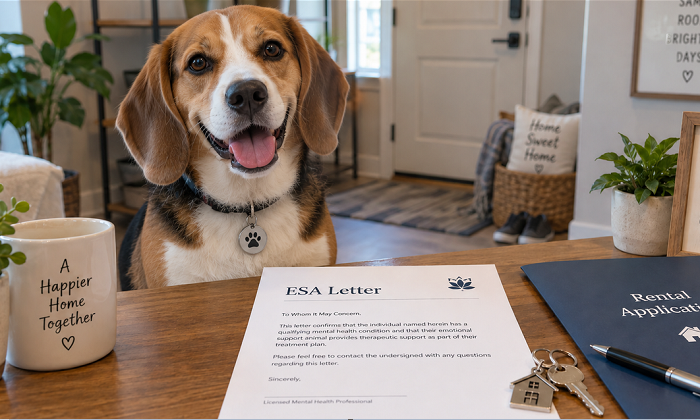
An ESA letter can still be useful when discussing accommodation with a landlord.
Typically, this is documentation from a licensed healthcare professional explaining that the person has a disability-related need for the emotional support provided by the animal.
It is important to clarify that a healthcare provider's letter relates to why you need the animal. An ESA certificate, registration number, vest, and ID card, on the other hand, may help identify the animal but they do not demonstrate a disability-related need.
If you are asking a landlord to make an exception to their usual pet policy, supporting documentation may help them better understand the reason for your request. It can be especially relevant in a state or city where local law specifically recognizes emotional support animals.
However, an ESA letter or any supporting documentation and identification gear should not be viewed as a document that automatically guarantees approval. Having one does not guarantee that every landlord must accept your ESA, particularly under HUD's current federal enforcement approach.
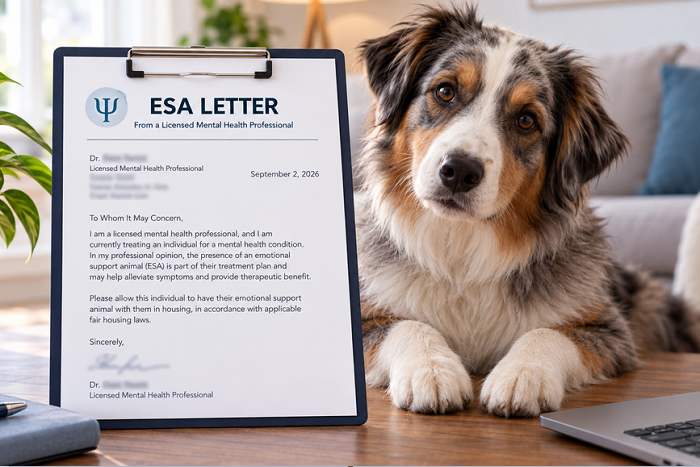
Generally, ESA documentation should come from a legitimate licensed healthcare professional and aims to verify the person’s need for an emotional support animal (ESA) due to their disability.
It does not have to provide your detailed medical history or disclose more private medical information than is required under the applicable rules.
If you need documentation for housing, you may consider consulting your healthcare provider directly and checking your local requirements before submitting it.

There is no federal ESA registry where you can officially register an animal and receive legal ESA status.
You can certainly have optional identification for your animal, and some people find an ID card convenient when explaining that their animal is an ESA. However, having an ID card does not mean that a landlord is automatically required to provide accommodation.
If you are requesting housing accommodation, documentation from a licensed healthcare professional may be useful because it can explain your disability-related need for the animal. An ESA certificate or ID card can still serve as optional identification, but they do not automatically carry the same weight when a landlord is reviewing an accommodation request.

A no-pet policy does not necessarily mean that there is no point in speaking to the landlord.
An emotional support animal is not automatically treated as a pet under every applicable housing law, and some federal, state, or local protections may allow a person with a disability to request an exception.
Even where the law does not require the landlord to approve your ESA, the housing provider may still agree to do so voluntarily.
A clear and respectful conversation can help. Rather than simply telling the landlord that they must allow the animal, explain that you have an ESA because of a disability-related need, ask whether they would be willing to accommodate your ESA, and what documentation they may require
If you have an ESA letter or other relevant documentation, you can provide it where appropriate.

This is another area where the rules can vary depending on where you live and which housing laws apply to your property.
HUD’s May 2026 enforcement guidance changed how FHEO approaches complaints involving untrained emotional support animals. Because of this, you should not assume that identifying an animal as an ESA will automatically exempt you from pet rent, deposits, or other pet-related charges in every rental property.
At the same time, state or local laws may provide additional or broader protections for emotional support animals, including rules about pet fees or deposits. This is why it is important to check the requirements that apply in your area before assuming that a charge is either allowed or prohibited.
It is also important to separate pet-related fees from responsibility for actual damage. Even where an ESA is accommodated, the tenant is usually responsible for any damage the animal may cause, just as they would be for other damage to the rental property.

Yes, they can. Whether an animal is an ESA, a service dog, or a pet, landlords have a legitimate interest in protecting both their property and other residents.
Your ESA should be well-mannered around other animals and people and should not create any disturbances. For example, uncontrolled barking, aggressive behavior, damage to the rental property, or repeatedly allowing the animal to roam uncontrolled can create problems regardless of the animal's emotional support role.
This is one reason why basic obedience and behavior training can be beneficial even though ESAs are not required to undergo the specialized task training expected of service dogs.
Documentation showing that your dog has completed obedience or behavior training may also reassure a prospective landlord that the animal is well-mannered and unlikely to create problems. However, please keep in mind that documentation showing completed obedience or behavior training does not replace a medical letter issued by a licensed healthcare provider.

If you need to request accommodation, you may wish to keep the process clear and cooperative, as this can help make the conversation easier.
You can explain that the animal provides emotional support related to a disability, ask what procedure the housing provider uses for accommodation requests, and provide appropriate supporting documentation where required. If your ESA has completed obedience training, you may also choose to mention this.
Presenting a medical letter confirming your need for an ESA can also be particularly helpful.
We also recommend that you keep your request and any responses in writing. This can help you keep track of what information was requested, what you provided, and the landlord's decision.
If your request is refused and you believe the law in your area protects your ESA, consider obtaining advice from a local housing organization, disability rights organization, attorney, or the relevant government agency.

Yes, they do.
Federal law is only one part of the picture when renting with an ESA in the United States. State and local laws may provide additional protections, and in some areas these protections are broader than HUD’s current federal enforcement approach.
For example, California continues to recognize emotional support animals as a reasonable accommodation in housing. In California, refusing to accommodate an ESA when it is needed because of a disability could be considered housing discrimination. Qualifying ESAs are also not subject to the breed, size, or weight restrictions normally applied to pets, and tenants cannot be charged pet deposits or pet rent for them. You can learn more in the California Civil Rights Department’s housing guidance.
“Can housing providers prohibit a tenant or resident from having an ESA?
Housing providers are allowed to have rules regarding pets, including prohibiting pets; prohibiting certain types of pets, such as large or wild animals; or prohibiting nuisance activity caused by pets, such as incessant barking.
4 However, if a tenant or resident has a disability-related need for an ESA, the housing provider must allow the person to have the animal as a reasonable accommodation, unless the housing provider can show that an exception applies."
Massachusetts also continues to provide specific housing protections for ESAs. According to the Massachusetts Office on Disability, both service dogs and emotional support animals can qualify as assistance animals under the state’s fair housing law. A person with a disability may request an exception to animal restrictions or fees, and a housing provider may ask for supporting documentation from a medical provider when the request involves an ESA.
ESA owners are not required to have special certification or identification. You can read more about emotional support animals and housing protections in Massachusetts in the Massachusetts assistance animals in housing guidance.
“Both emotional support animals (ESAs) and service dogs meet the definition of an assistance animal under the Massachusetts fair housing law. If an individual has a disability-related need for an assistance animal, they can ask their housing provider for a reasonable accommodation to exempt their assistance animal from any animal restrictions, policies or fees that would otherwise pose a barrier to their equal enjoyment of their housing.”
In Ontario, Canada, the Ontario Human Rights Code requires housing providers to accommodate disability-related needs up to the point of undue hardship. Ontario guidance also recognizes that tenants may need an animal because of a disability, although it generally uses the term “service animal” rather than “emotional support animal.” However, landlords in Ontario must also comply with the Residential Tenancies Act (RTA), which states:
“76 (1) If an application based on a notice of termination under section 64, 65 or 66 is grounded on the presence, control or behaviour of an animal in or about the residential complex, the Board shall not make an order terminating the tenancy and evicting the tenant without being satisfied that the tenant is keeping an animal and that,
(a) subject to subsection (2), the past behaviour of an animal of that species has substantially interfered with the reasonable enjoyment of the residential complex for all usual purposes by the landlord or other tenants;
(b) subject to subsection (3), the presence of an animal of that species has caused the landlord or another tenant to suffer a serious allergic reaction; or
(c) the presence of an animal of that species or breed is inherently dangerous to the safety of the landlord or the other tenants. 2006, c. 17, s. 76 (1).”
In England, the legal approach is different again. There is no equivalent U.S.-style ESA category, but under the Renters’ Rights Act, many private tenants can request permission to keep a pet and landlords must consider the request rather than refuse automatically. You can read more in the GOV.UK Renters’ Rights Act guidance for tenants.
These examples show why two people renting with very similar animals may have different rights depending on where they live. Before approaching a landlord, please make sure to check the laws that apply in your state, province, country, or local area, particularly if the property has a no-pet policy, charges additional pet fees, or your request to keep an ESA has already been refused.

Having an emotional support animal does not automatically guarantee an exception to every rental policy, but it also does not mean that finding suitable housing is impossible.
As a first step, research the regulations that apply where you live. If appropriate, obtain supporting documentation from a licensed healthcare provider and communicate openly with your landlord about your need for the animal.
Most importantly, remember that an ESA certificate, ID card, or registration can be helpful for identification, but none of these replaces understanding your actual housing rights. A good approach is to know the laws in your area, have relevant documentation available when needed, and make sure your ESA is a well-behaved member of your household.